


Page 60 - Spring 2024
P. 60
We Need Your Help


        Keeping this magazine fresh and full of new ideas is a tall   articles. With the internet you need not be local to provide
        order. We are looking for help from alumni who would be   this service to the newsletter. E-mail makes submitting
        willing to:                                               articles convenient and easy.

        Submit articles on a routine basis. We thank Barbara Howe   Have you ever considered lending a hand to the Houlton
        Hogan ‘63, Karen Eleiott Donato ‘69, Paula Woodworth      High School Alumni Association, but wondered how you
        ‘70 and Barbara McGillicuddy Bolton ‘61 for their work on   could best help out? Many folks have stepped forward to
        articles in the past.                                     share their time and talent in other areas. Help continue the
                                                                  legacy of the North Star Magazine by considering one of the
        We need others willing to do so. Several can be written   jobs listed above.
        ahead and kept in our files and used as needed. Articles can
        be on any topic that one thinks might be of interest to the   Contact the Alumni Secretary, Patty Donovan Fitzpatrick
        HHSAA readership. Tales from days gone by are always well   at mslittleton@pioneercable.net on how you can help out.
        received. Get permission from magazines to let us reprint

                                                                     CORRECTIONS
                                                                     CORNER

                                                                     No Known Corrections for This Issue


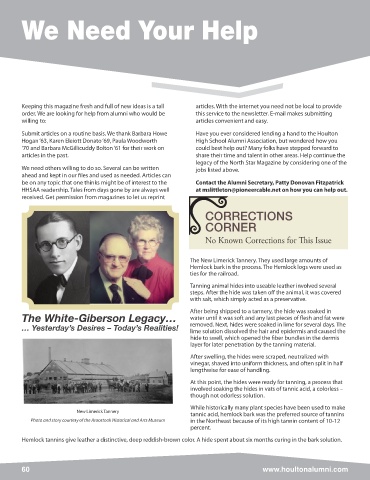
                                                                The New Limerick Tannery. They used large amounts of
                                                                Hemlock bark in the process. The Hemlock logs were used as
                                                                ties for the railroad.
                                                                Tanning animal hides into useable leather involved several
                                                                steps. After the hide was taken off the animal, it was covered
                                                                with salt, which simply acted as a preservative.
                                                                After being shipped to a tannery, the hide was soaked in
        The White-Giberson Legacy…                              water until it was soft and any last pieces of flesh and fat were

        … Yesterday’s Desires – Today’s Realities!              removed. Next, hides were soaked in lime for several days. The
                                                                lime solution dissolved the hair and epidermis and caused the
                                                                hide to swell, which opened the fiber bundles in the dermis
                                                                layer for later penetration by the tanning material.

                                                                After swelling, the hides were scraped, neutralized with
                                                                vinegar, shaved into uniform thickness, and often split in half
                                                                lengthwise for ease of handling.
                                                                At this point, the hides were ready for tanning, a process that
                                                                involved soaking the hides in vats of tannic acid, a colorless –
                                                                though not odorless solution.
                                                                While historically many plant species have been used to make
                          New Limerick Tannery
                                                                tannic acid, hemlock bark was the preferred source of tannins
           Photo and story courtesy of the Aroostook Historical and Arts Museum  in the Northeast because of its high tannin content of 10-12
                                                                percent.

        Hemlock tannins give leather a distinctive, deep reddish-brown color. A hide spent about six months curing in the bark solution.


        60                                                                              www.houltonalumni.com

